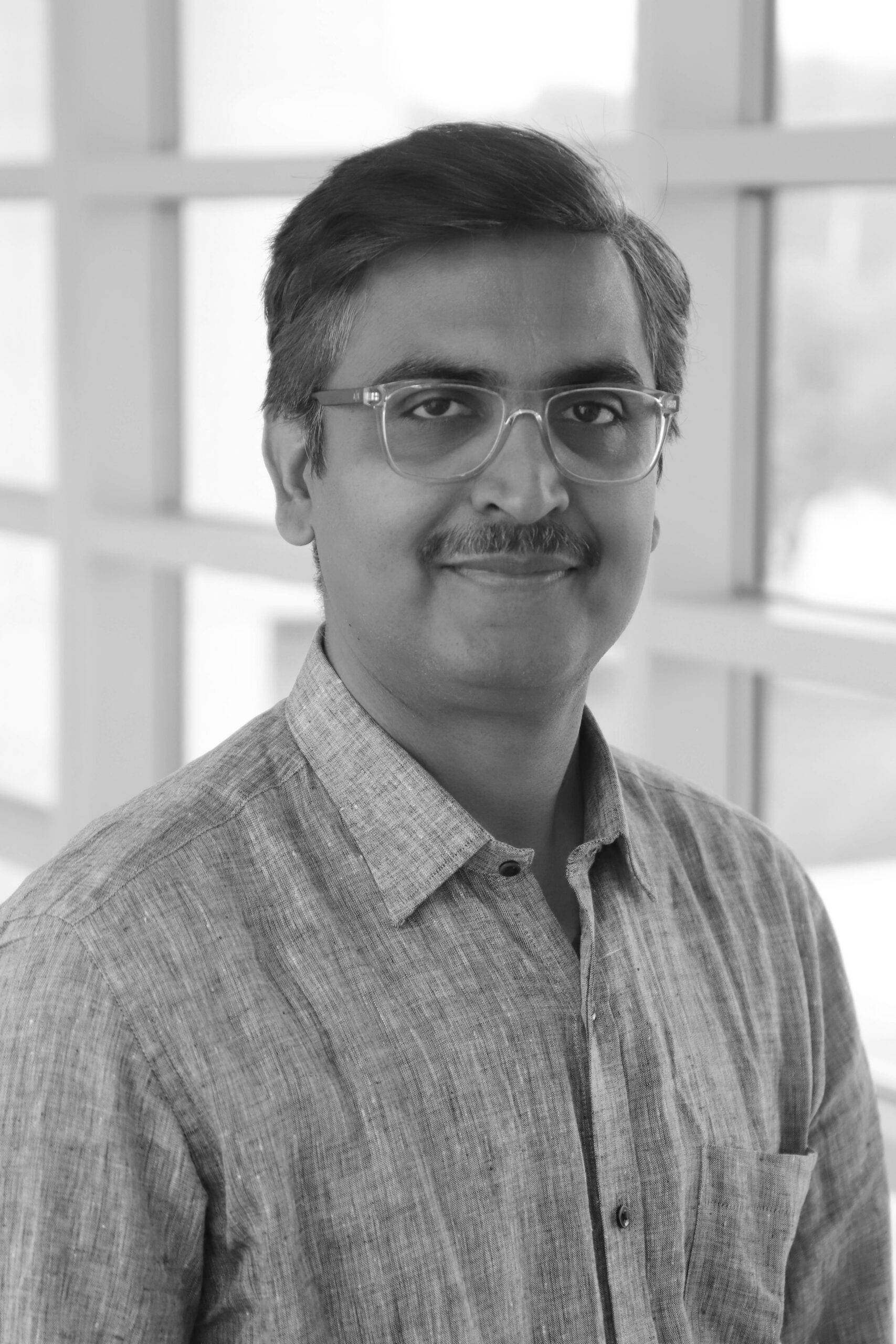
Associate Professor
Anirban Adhya, Ph.D., is an Associate Professor of Architecture and Urban Design at Lawrence Technological University. His work focuses on the theoretical, methodological, and systemic dimensions of architecture within urban contexts, exploring the relationships between built environments, ecology, and social systems.
His scholarship connects urban ecology, spatial typology, and everyday urbanism through critical perspectives on human–nature interaction, ecological well-being, and social ethics.
Dr. Adhya has collaborated with communities in Buffalo, New York; Warren, Michigan; and Seattle, Washington. As a Fulbright Specialist (2019–2024), he has contributed internationally in Costa Rica, India, and Italy.
In addition to his teaching and research, he is a founding member of the SYNCH Research Group and contributes to community-based initiatives such as LTU’s Detroit Studio, which focuses on urban engagement in the metropolitan region.
Dr. Adhya has authored and co-authored numerous books, journal articles, and research papers on urban design and sustainability, exploring foundational concepts in designing human-centered urban environments. His research has been published in academic journals such as Volume (Archis) and the Architectural Research Centers Consortium (ARCC) Journal, and has been supported by organizations including the American Institute of Architects and the University of Michigan.
Adhya, A. & Plowright, P. (2023). Urban Design Made by Humans. New York: Routledge.
Adhya, A. (2017). Shrinking Cities and Suburbs: The Case of Detroit and Warren, Michigan. New York: Palgrave Macmillan.
Adhya, A. & Plowright, P. (2017). Wilderness as City: Conflicting Values in Framing Sustainable Urbanism. Curtright, L. & Bremm, D. (Eds.). Sustainability and the City: Urban Poetics and Politics. Lanham, MD: Rowman & Littlefield.
Adhya, A. & Plowright, P. (2016). Sustainable Architecture as Ecology: Defining shared systemic priorities of public health and social ethics in places. Khan, A.Z. & Allacker, K. (Eds.). Architecture and Sustainability: Critical Perspectives for Integrated Design. Leuven (Belgium) / Den Haag (Netherlands): ACCO.
Adhya, A. (2015). Durga Pujo in Kolkata. The City & South Asia. Cambridge, MA: Harvard South Asia Institute, pp. 49-51.
Stevens, J. & Adhya, A. (2013). The Interstitial Challenge: understanding manifestations of terrain vague through an inquiry into the social and environmental dilemmas of Detroit, USA and Clichy-sous-Bois, Paris, France. Baron, P. & Manuella, M. (Eds.). Terrain Vague: The Interstitial as Site, Concept, Intervention. New York: Routledge.
Adhya, A. (2012). Jane Jacobs and the Theory of Placemaking in Debates of Sustainable Urbanism. Hirt, S. with Zahm, D. (Eds.). Urban Wisdom of Jane Jacobs. New York: Routledge.