


The machines look finished.
They’re clean. Assembled. Ready to be rolled out and shown. But in the lab, nothing feels finished.
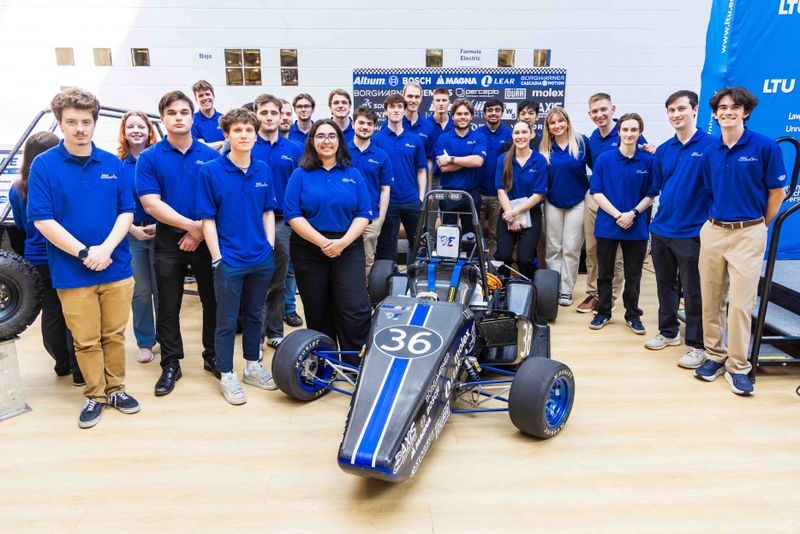
Franco Bella stands over the car his team has spent months building, watching as another system check runs. The chassis is complete. The engine is in. Most of the major pieces are where they should be.
That doesn’t mean it’s ready.
“You get to a point where everything looks done,” said Bella, an LTU Mechanical Engineering student and captain of the Formula SAE team, one of five Blue Devil Motorsports teams. “And then you start finding what isn’t working.”
Something always needs one more adjustment. One more test. One more fix before anyone is willing to trust it. Because once this car leaves campus, there’s no stepping in when something goes wrong.
It holds or it doesn’t.

For Bella and the Formula SAE team, everything comes down to a single moment. The first time the car moves under its own power. Until then, everything is an assumption.
The chassis has been redesigned to be lighter and more rigid. That gives the car speed and control, but it also makes problems impossible to ignore. If something is off, the car will show it immediately. A Yamaha R7 engine tuned for E85 sits at the center, but the real challenge is everything working together at once. Suspension. Electronics. Drivetrain. Aerodynamics.
“You have to explain and defend your decisions to the judges,” says Darrell Hancock Jr., a technical fellow for vehicle dynamics at Stellantis and an adjunct professor in LTU’s College of Engineering. “But in the end, the car’s performance shows how good those decisions were.”
In May 2026, Bella and the team brought the car to Michigan International Speedway. That’s where the questions got answered.
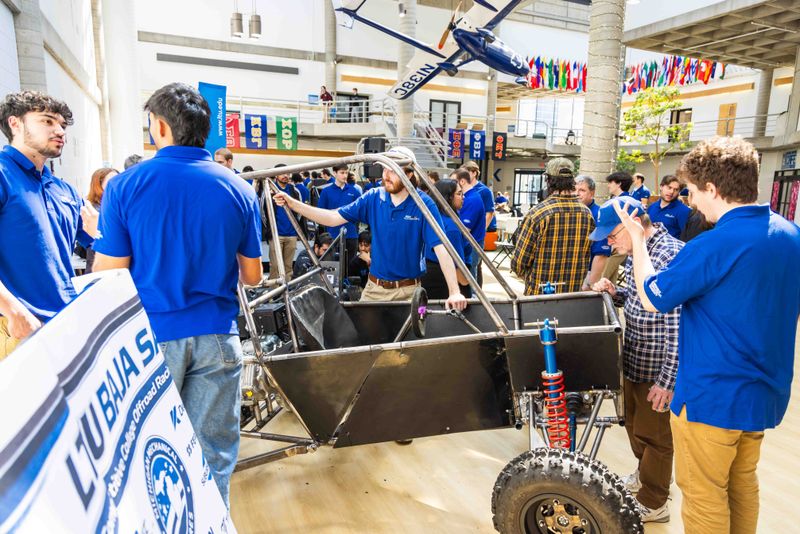
Blue Devil Motorsports consists of the Formula SAE, Formula Electric, Baja SAE, SAE Aero Design, and the Intelligent Ground Vehicle Competition teams. Together, they include students from engineering, business, design, and technology disciplines who work together to design, build, test, and compete with high-performance vehicles in national collegiate competitions.
The Baja SAE team doesn’t get more power. Every team runs the same engine. No modifications. No edge.
So performance comes down to choices made early and tested under pressure: How light can the frame be before it breaks? How much punishment can the suspension take? How long can the car last when the course doesn’t let up?
With only six students on the team, there’s no margin for delay. If something falls behind, everything slows down.
“If you don’t understand how every choice affects everything else on the car, you’re already behind,” Hancock said.
By the time they reach the competition in New York, more than a hundred teams will be competing with vehicles built for the same challenge.
Only some will hold up.
The Formula Electric team works in a different kind of environment. No engine noise. No distraction. No cover. If something hesitates, it shows up immediately. They spent months securing sponsors and refining the design. Now everything has to work together in a system that doesn’t tolerate delay.
The goal was simple. Build by mid-March. Test to find what works, what doesn’t, and what could work better. Because there are always improvements to be made.
“At some point, the design has to be finalized and execution takes over,” Hancock said.
The SAE Aero Design team ran out of time before they ran out of questions.
They flew a prototype in zero-degree weather back in January. It worked, but it wasn’t the competition plane. The final aircraft never got a real test window. A few days in late February were lost to high winds, and the team moved forward without a clean flight.
They arrived in Florida without knowing.
On March 6, one day before competition, they finally got it in the air. Eighty-five degrees. Different conditions. More pressure.
“You can simulate all you want,” said Andrew Gerhart, professor and faculty advisor in LTU’s College of Engineering, “but until it flies, you can’t be certain.”
It flew.
The pilot called it smooth, like a trainer. After that, he wanted more weight. The team added it, flight after flight. The stress showed. Landing gear broke. Electronics failed. Cracks formed in the wings. Between rounds, they worked fast, fixing, reinforcing, getting back in line.
No reset. Just the next run.
By the final day, the choice was clear: push it to the theoretical limit or hold back.
They held back.
Barely.
The plane cleared the 100-foot line with inches to spare. That final flight pushed LTU to eighth out of about 40 teams, fifth among U.S. programs, ahead of Michigan and Purdue.
It wasn’t perfect.
But it held.

For the Intelligent Ground Vehicle Competition team, a student-led group that designs, builds, and tests autonomous or semi-autonomous ground vehicles for competition, the system has to make its own decisions. Using LiDAR, cameras, and GPS, the vehicle reads its surroundings and chooses how to move. No one steps in if it gets it wrong.
If it hesitates, it fails. If it misreads the terrain, it fails. If it overcorrects, it fails. There is no fallback at this point.
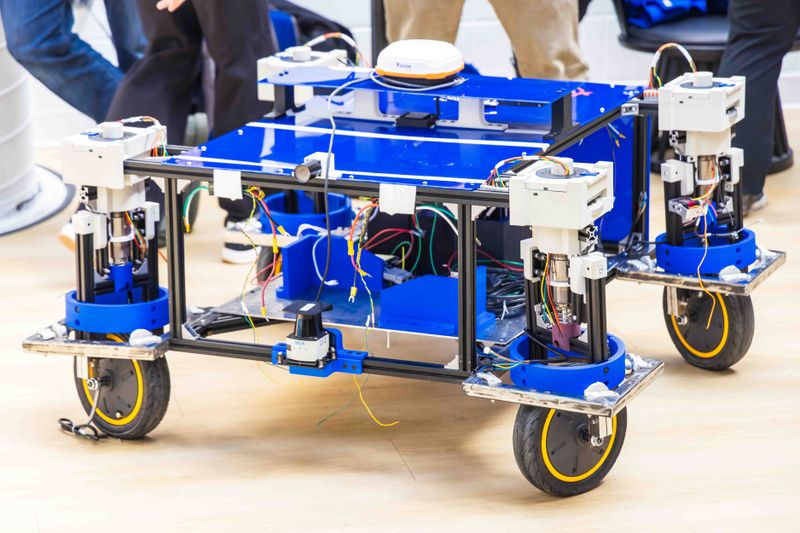
On April 7, the vehicles were lined up in the Buell Building atrium. They’ll look complete.
Ready. Set. Go.
Bella knows what people won’t see. What’s working? What still isn’t. What hasn’t been tested yet. What’s on display is only what’s ready that day. After that, everything changes. The track exposes weaknesses. The terrain finds what wasn’t reinforced. The system reveals what wasn’t fully understood
There are no explanations there. No extra time.
“We’ll find out pretty quick if we got it right,” Bella said.
For him and every team in Blue Devil Motorsports, the outcome is simple: It holds or it doesn’t.


